2016 — 2017
Turning Research
into a Commercial Product
Taking SMPL, a state-of-the-art academic body model, and building an eight-capability commercial platform across two markets, resulting in acquisition by Amazon.
The Challenge
The world's best body model — with no product strategy
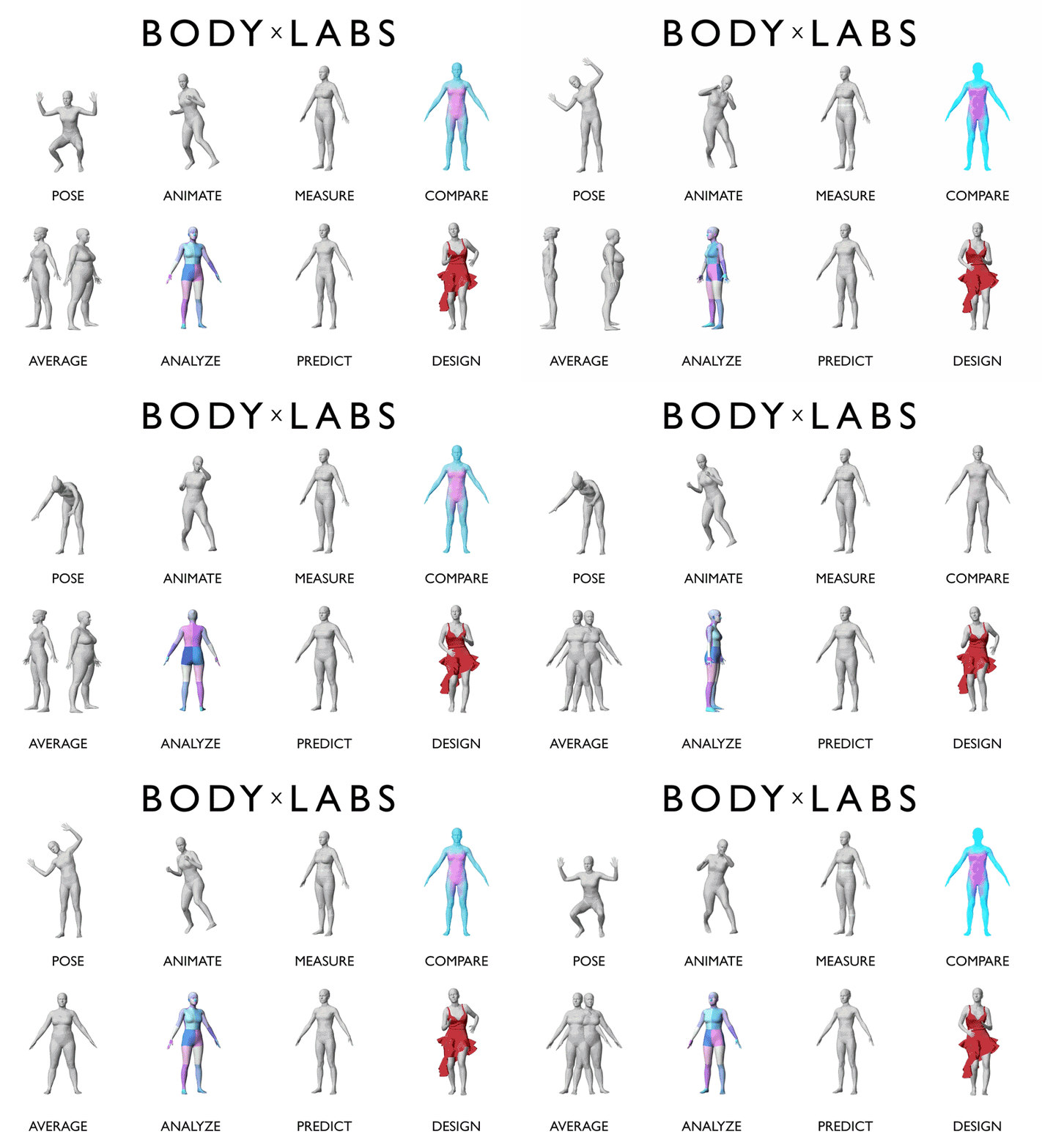
Body Labs had licensed SMPL (Skinned Multi-Person Linear model) from the Max Planck Institute, one of the most sophisticated statistical body models ever built. It could describe the shape of any human body as a compact mathematical representation, enabling photorealistic pose, animation, measurement, and prediction from a single scan or photo.
But having the best body model in the world isn't the same as having a product. As the sole PM, the challenge was to determine who would actually pay for this, which capabilities to build and in what order, and how to serve two entirely different markets, B2B apparel and B2C consumer tech, without fracturing the platform into two separate products.
Pose
Animate
Measure
Compare
Average
Analyze
Predict
Design
Eight distinct capabilities shipped from a single underlying body model
The Approach
Two markets. One platform. One PM.
Dual-Market Strategy
- B2B — Apparel & Footwear: Sizing systems, virtual fit analysis, and design tools for brands who needed to build products for bodies they had never accurately measured
- B2C — Gaming & Fitness: Personalized avatars, body tracking, and movement analysis for consumer platforms and developers
- Wrote product specs, ran rapid prototyping cycles, and worked directly with engineering to sequence capabilities by market traction, not technical simplicity
- Maintained one coherent API across both markets, avoiding the organizational drift that comes from building two siloed products
B2B Market
Apparel & Footwear brands
Sizing · Fit Analysis · Virtual Try-On · Design Tools
↕ single platform, two buyer types
B2C Market
Gaming & Fitness platforms
Avatars · Body Tracking · Movement Analysis
Product Video
Body Labs Blue — B2B Measurement Tool
The commercial platform in action: real-time 3D body measurement for apparel brands and fitness applications.
Laser Scanners
Lab-grade hardware. High accuracy, zero scalability.
→
Smartphone Cameras
Consumer-grade input. New calibration pipeline required.
→
CNN Inference
Body shape from a single image. No hardware at all.
Democratizing the Input Layer
- Started with lab-grade laser scanners. Maximum accuracy, zero commercial scale.
- Pushed to rebuild the pipeline around smartphone cameras, enabling any consumer to submit body data without specialized hardware
- Oversaw training pipelines for CNNs that could infer accurate body shape from a single photograph. No scanner, no markers, no controlled environment.
- Each generation of input method expanded the addressable market by orders of magnitude
Rapid Prototyping & Prioritization
- Built PRDs for each of the eight capabilities, with clear success metrics tied to specific buyer personas
- Ran developer workshops to understand how B2B and B2C customers wanted to integrate the API. Adjustments based on real integration friction, not assumptions.
- Deprioritized technically impressive capabilities (like population averaging) in favor of commercially urgent ones (like measurement and fit prediction)
- Maintained sprint velocity as sole PM across a cross-functional team of ML engineers, frontend developers, and 3D graphics specialists
Technology Demo
SOMA — CNN Photo-to-Body Technology
Demonstrating the full pipeline: from a single smartphone photo to an accurate 3D body model using computer vision. No scanner, no markers required.
Key insight: The best body model in the world is worthless if the input method requires a $50,000 lab scanner. The real product innovation wasn't the model itself. It was making the model accessible. Democratizing input (laser to phone to single image) was what unlocked scale. A product decision disguised as a technical one.
Why It Matters
Research is a starting point, not a product
The Body Labs experience established a pattern I've seen at every company since: organizations with genuinely world-class technical capabilities that struggle to turn them into products. The gap isn't technical. It's strategic. Finding the right market fit, scoping what to ship first, and building a platform that serves multiple buyers without fragmenting. That's the PM work.
The move from laser scanner to smartphone camera was a product decision that looked like a technical one. Recognizing those moments, when a seemingly technical choice is actually a market-shaping decision, is the core of this kind of work.